
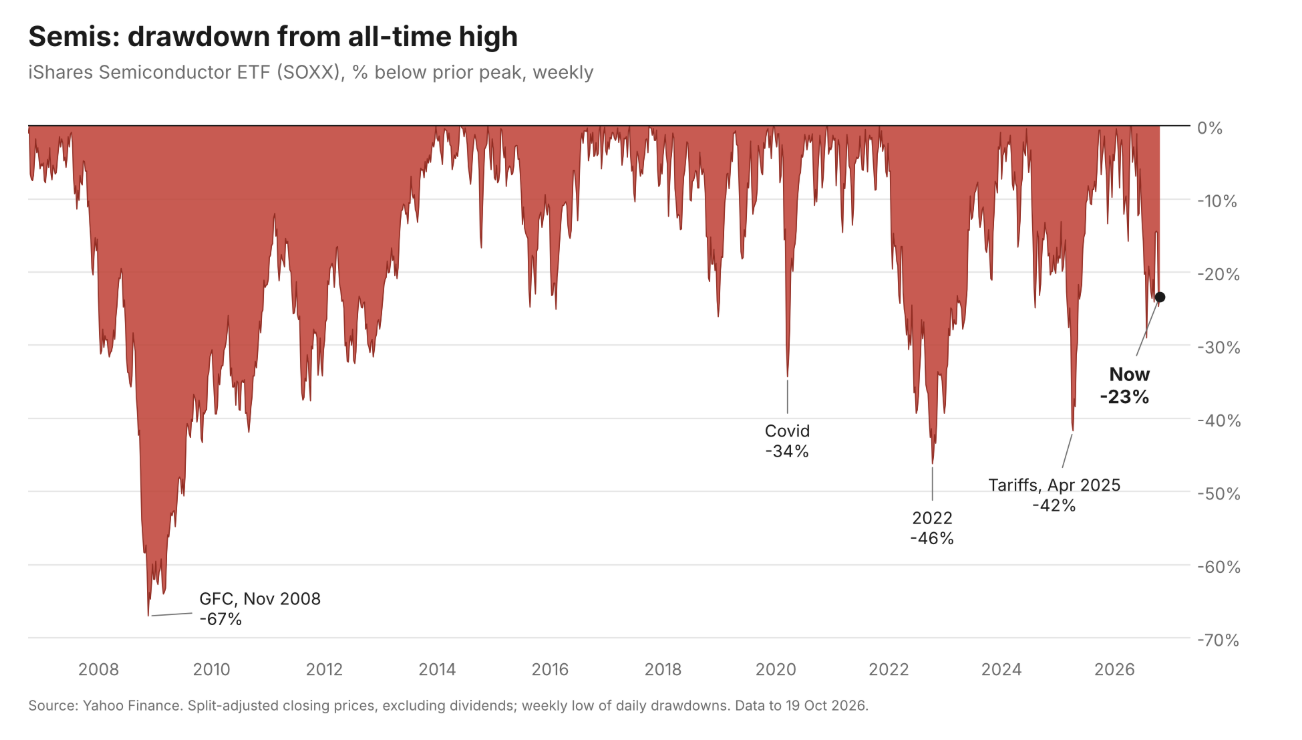

It seemed a stretch ten days ago that Firmus could tank the global AI trade, but so it has. A series of IPOs have been pulled, bonds sold off, and the AI trade retraced.
This came in a week where Taiwan Semiconductor and ASML announced substantial earnings beats and forecasts, so there was plenty of power behind the selling. Goldman reported hedge funds as a group had wiped out their entire net AI exposure.

Yet even last week memory prices rose and live GPU rental prices lifted. A tricky one to unpack.
Firmus was the first domino to fall in a closing market for neoclouds
I can only imagine what would have happened had a Firmus IPO soaked up what little demand for leveraged speculative neoclouds there was. If tens of billions of capital actually tried to exit in this market, the stock would have been a disaster; there’s simply no other side to that trade.
If Firmus wasn’t the cause, it was certainly the marker of a new regime.

The AFR reported the company’s earlier ~$15 billion round had all kinds of protections for later investors, including automatic dilution if an IPO fails, and even the right to put back the shares.
As with the IPO, the detail is all in the fine print.
Private markets are scary.
It’s very possible for later investors to win terms at the expense - sometimes total - of earlier investors, who you would normally expect to do best.
These terms allow a firm to market a higher valuation (your price, my terms), but the headline numbers are not really equity valuations when they come with so many protections and credit features.
They do serve a purpose though: those higher numbers excite the media and early investors, and anchor the next set of buyers.
The public talking points around Firmus seemed very much at odds with the fine print in the strictly guarded prospectus. I believe this ultimately worked against the deal, as details were slowly released throughout the week, creating an increasingly toxic atmosphere.
A more transparent process might have forced a smoothing of the rougher edges in the terms, and enabled better price discovery and a valuation that might have actually succeeded. Now we will never know.
But NScale may give us a clue!
The company planned to list at $30 billion on similar numbers to Firmus, with a similar Nvidia-style relationship, and even some of the same pre-IPO backers (who will be sweating right now).
As with Firmus’s flooded data centre and missed rental payment, NScale hit operational issues at the finish line, as Microsoft pulled out of what was going to be a major site after their grid connection got pushed out to the 2030s. Other than prospective sites and unfunded plans, there’s little existing value to fall back on.
Yours for $30 billion:

But at least this time there is talk of cutting the IPO price by 43%.
We’ll soon know if the market is entirely shut to these kinds of deals, or if it was more a matter of valuation.
Alas, the contagion has spread regardless: first to neoclouds, then to the rest of the AI and semiconductor trade. And given the importance of the data centre build-out to the global economy, it may go further.
CoreWeave
The center of the storm moved to CoreWeave, highlighted by Firmus as a comparable, but ~200x the size and roughly the same valuation.
CoreWeave’s debt sold off significantly, as did related neocloud bonds and CDS.
This is the company that reported $1.5 billion of adjusted EBITDA, but a net loss of $640 million, struggling to turn a profit selling a scarce asset in a shortage.
And also offering a fine demonstration of how management can redefine losses as earnings.
We saw this in Australia too, where proud EBITDA numbers were thrown around (a forecast of $10 billion was thrown out at one point) when a cursory examination of income statements shows losses.

Debt is contractual, you can’t pay interest and capital repayments with accounting adjustments.
The raison d'être of these companies is off-balance sheet financing. Their economics are squeezed by both their suppliers and customers, and their main value add to their ‘partners’ is raising the money to fund the economic and risk transfers.
On one side they have as their exclusive supplier one of the most powerful companies on the planet, Nvidia. On the other, you have many of the rest: Microsoft, Meta, Amazon, etc.
All of whom must be delighted to find someone willing to lease them capacity at a 24% loss while taking on the entire residual risk of GPUs.
You could also argue they serve a third master, financiers, who earn substantial fees in both equity and debt financing, and also want these to succeed.
So neoclouds are price takers from all three sides: their supplier Nvidia, their hyperscaler customers, and financial markets.
I don’t see how a -24% loss margin is sustainable for these companies, and increasingly neither does the rest of the market.
Kick ons
CEO Jensen Huang referred to $80 billion of orders from Firmus. But if that could appear and vanish so quickly, how real is the rest of the pipeline?
If financing markets are indeed shut to these companies, how far will they have to scale back their expansion plans? And will this be lost future capacity, or does it just go to someone else?
Reducing leveraged excess in the system is undoubtedly a good thing, taking the pressure off both the supply chain and the markets.
Notably, after two hot inflation prints last week, yields actually fell, so we may be reaching an end game here where scaling back debt-funded growth expansion plans take the pressure off rates too.
Attempting to do >$50-100 billion projects in thinly capitalised, fragile entities is highly destabilising and not good for anyone. Projects this size should sit on well-capitalised, profitable companies like the hyperscalers, or even state balance sheets.
The best strategy for the listed neoclouds (privates don’t have the option) is to slam the market with the largest at-the-market equity offerings they can, and (in CoreWeave’s case) convert as much of their $34 billion market cap into cash as possible. This would hurt the stock, but is better than the alternative.
And it would also close the gap between bonds pricing in default and a company that still has significant market value. Insiders are certainly taking that approach on their own accounts:

Heavy insider selling
Besides, if GPU returns are so good to neoclouds, why aren’t these companies funding their expansions with equity?
Understanding that is the key to unlocking the puzzle. The reasons are not pretty.
Nvidia’s Harem
And now all eyes are turned back to Nvidia. What will they do? They support hundreds of these companies and formed many of them through their backing. It’s estimated that ~15-20% of Nvidia’s revenue comes from the sector. Can they really afford to let this harem of neoclouds go under?
They may have to.
I don’t think it a coincidence that their most aggressive financing deals were done overseas, given rumours around antitrust.
A relationship with Nvidia is exclusive, but only in one direction.
It has been an open industry secret that, public friendliness aside, Nvidia expects loyalty:

And the risk of technological obsolescence is manifesting early.
Last week Microsoft revealed more details on their latest Maia chip, with 30-40% cost efficiencies vs the latest Nvidia chips, and a plan to move the bulk of their inference onto their own supply.
Google too announced the seventh generation of their TPUs, offering 30-50% total cost savings over Nvidia’s Blackwell.
The fruits of these investments in vertical integration are why we think that when it comes to chip values, the next five years will be different to the last.

So where to from here?
We have a financial contagion ripping through the leveraged corner of the AI trade, multiple pulled IPOs, and listed debt trading down to distressed levels.
Yet GPU leasing rates are rising, memory makers are hiking prices and token demand is still rising. New formats like Grokbot and Meta’s Muse are attracting millions of users.
The actual ‘physical’ market for AI is tight, even while the financial markets, specifically those around leveraged players are now broken.
Sometimes markets sniff out cycle changes in advance. Other times, a scare creates a multi year buying opportunity. The last two major scares, DeepSeek and Trump’s Tariff scare both marked major lows.
Memory makers are down 30-50%, much of that in the last week, yet they are still raising prices. By some estimates SK Hynix will earn 10% of its market every quarter next year.
Ultimately the customer and end demand will determine the outcome for these companies.
But first, there’s a far larger IPO that will put markets to the test. Anthropic is an entirely different category to the neoclouds, but it looks like they are making some of the same mistakes.
Success here would indicate financial stress is isolated, a delay would have implications for the entire semiconductor cycle. Next note…
Mike