
Explosive AI demand vs rising rates, what comes out on top?
September investment update

Michael Frazis
September 26, 2026
Hello all,
In August our wholesale fund declined -0.1% and we are up modestly so far in September. Our rolling three year net return is over 32% pa.
I’m in Melbourne Tuesday/Wednesday and will host drinks at our office in Sydney this Thursday so please get in touch if you’d like to attend. We will have to give priority to existing investors but reply to this email if you want more information.
I wrote a couple of weeks ago that our models gave a wave of buy signals, and while it looked a little early after Dario and Sam Altman sounded called for a slowdown and triggered a shake-out, the recovery was swift.

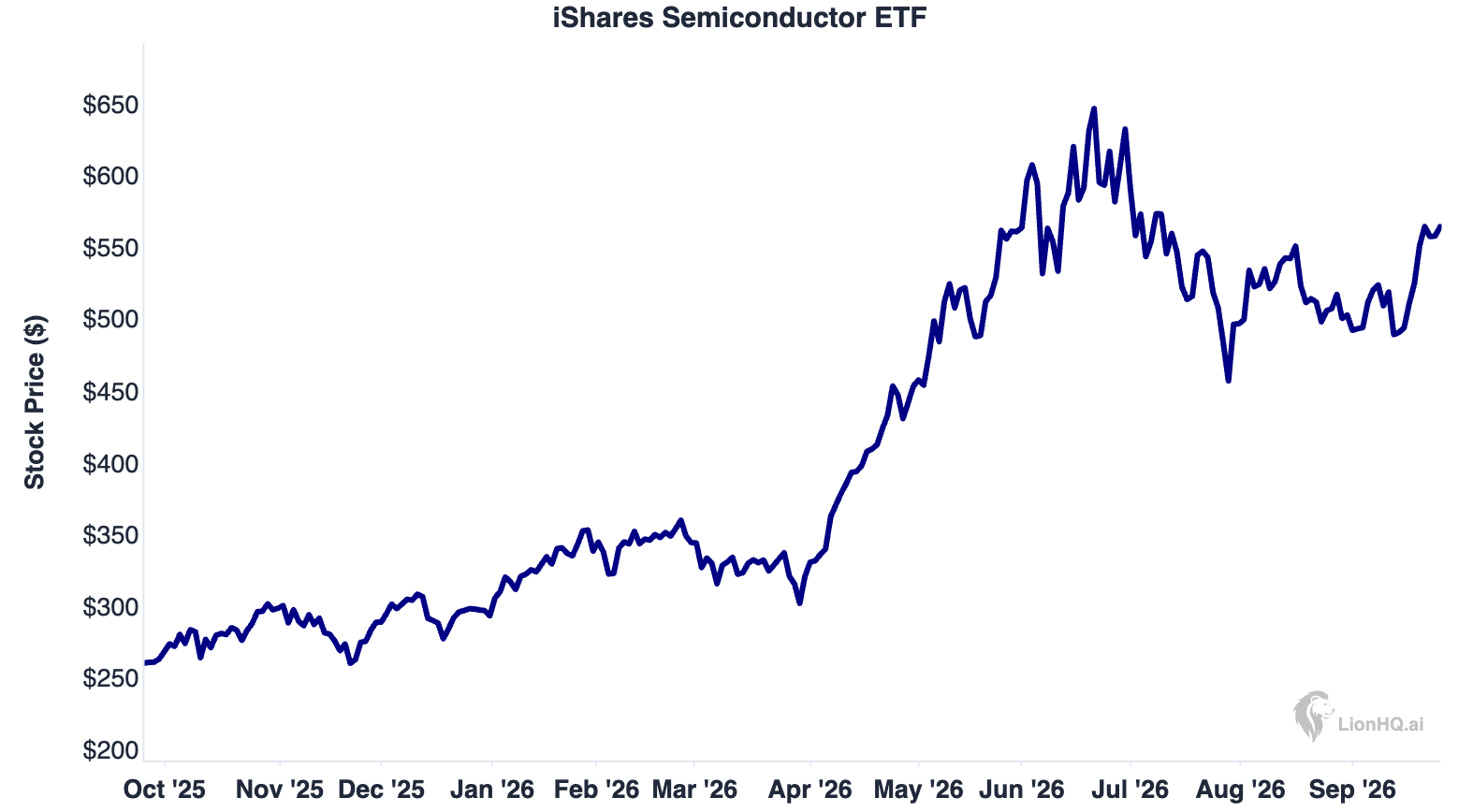
SOXX (iShares Semiconductor ETF) staged a partial recovery in September, after a 29% drawdown in July-August
And as always, watch what they say not what they do: both firms released new flagship models since making those statements barely a week ago.
Long time readers will know that we talk about true customer love as a guide to finding standout investment opportunities, pointing to queues at Apple, waiting times at Tesla, and more recently sold out capacity at Nvidia.
All three were multi trillion dollar profit opportunities in highly competitive industries where most companies failed, or posted mediocre returns as they competed desperately with each other on price and features.
Today, there is a similar effect with Anthropic and OpenAI. Both companies have been straining to serve their own models, even to premium paying customers, and this looks like another textbook case study. This explosive end customer demand, more than anything else, is what is driving our conviction in semiconductors.
Anthropic weltered under demand a few months ago, and we were early on the switch to OpenAI/Codex… and over the last two weeks it seems the rest of the community caught on, OpenAI overtook Anthropic in enterprise demand, and it was OpenAI’s turn to throttle demand, even switching off premium plans to new customers to manage.
Now, we are back on Anthropic. It feels like we’re on a boat where everyone is rushing from one side to another, and for now that’s the state of play.
It’s crystal clear that even in late 2026 the market is short compute.
Meta has finally struck consumer gold with their Muse app, with over 2.5 million users already, and will be extremely hard to beat. Apparently most of these new AI users are new to AI as well.
Each Chatbot gets its own virtual machine, so CPU makers like Intel and AMD have outperformed a ripping semiconductor sector. For the first time in a while we now own META.
But broadly we’ve done our buying now, so it’s a waiting game.
Hyperscaler vertical integration, as they move compute onto their own chips custom designed for their own (mostly inference) workloads
Optical interconnects replacing copper cabling where possible in datacenters
CPU growth and broad compute manufacturing capability
Where we are not investing is in neoclouds, where there is some exceptionally misleading marketing, dutifully picked up by financial newspapers.
There are a number of scaled operators right now in the United States, for example Nebius, trading at US$64 billion.
They’re doing US$2 billion of revenue (last quarter’s run rate), and showing ~$600 million of operating losses. This is before capex, which is substantial. So it’s worth considering what these operators look like at scale, in an environment where supply is so constricted that the two major players are struggling to serve their customers.
There’s many of the usual tricks on display … using ‘as-complete’ valuations (with the recent chaos in Aussie private credit and real estate development a good example of how badly this can go wrong), using multiples on steady-state ‘EBIT’ numbers which exclude major costs, and conveniently ignoring that when massive debt is used to finance rapidly depreciating assets, that debt needs to be repaid before equity, and can’t simply be refinanced.
Our base case is that within five years the entire current generation of GPUs will be replaced in five years by inference-specific specialized chips by both new entrants (eg Cerebras and Nvidia-owned Groq) and hyperscaler custom chips. This is entirely consistent with current market pricing and the fact five year old GPUs are still operating profitably.
The pace of innovation has changed… Nvidia’s next generation Vera Rubin is 1.5-3x more efficient than Blackwell. And there will be multiple new generations over the next five years. Which is why it’s such a risky bet taking on huge amounts of debt to buy today’s GPUs.
The key point here is not that these aren’t profitable today or over the next few years, but rather that actual free cash flow will have to pay down the debt before anything flows to equity.
This is very different to (say) a software business where cohorts can pay more and more many years into the future, and growth spend today can be repaid over the lifetime of a customer. In these businesses, the capex will have to be spent again, and again, to retain the same customer. And with rising base rates and neocloud spreads across the sector (see Oracle’s recent bond blowup), the total financing cost is vastly higher than the actual capex amount.
Which again we can see in real time in a different sector, in the real estate collapses in Australia where the total debt owing is vastly in excess of what was spent on the assets.
An as-complete multiple analysis conveniently sidesteps all of this.
There are many better ways to invest in AI (not least Nvidia), but more on that another time.
The amount of finance demanded by AI infrastructure is clearly putting strain on global debt markets, and is now past the point where it’s meaningful on a nation/global scale and I suspect at least partly behind rising interest rates around the world.
Ultimately, how long this goes for will come down to the customer, which is where we always like to start. And for now, even after all the investment over the last four years, there is simply not enough compute.
As mentioned please let me know if you’d like to catch up in Melbourne or Sydney. We are also organising an Adelaide and Perth trip in October so please reply to this email if you’d like more information.
Best wishes
Michael